Thursday, August 09, 2012

A Beautiful Community

My first steps did not take me far.

The considerations that will eventually define an online identity are so numerable it seemed I would never be able to identify, much less fulfill the essential criteria.

Sitting outside of the experience, the steps required for manifestation are a mystery. What seemed so straightforward from the passive position of “reader” or “follower” began to multiply into obstacles the closer I got to launching my own vehicle. I needed to identify the certain principles that would help to make my blog not only function, but relevant, as well.


In the act of collecting the pearls of other people’s online publishing experience, I have been able to work my way into this process. The sharing made it seem not only possible but inevitable, as a modern writer and I have been both encouraged and energized by the spirit of revolution that accompanies this surge in independent publishing. The community created by this exchange became a driving force in continuing when I discovered the glut of material that intends to cover the experience of writing. Through this dialogue, I was able to do the work in a way that I had only very generally hoped; relevance was determined by the excellence of shared experience.


The act of creating and of approaching the potential of participating in a larger system of exchange feels like an expansion.

The publishing experience began to take on a spiritual dimension, in that I found safe harbour and the knowledge to expand what had previously been provided by my limited conscious self. Up until this point, my sense of gratitude has been silent and directed at collecting this wonderful information. Going forward, I plan to add my voice to this wave of knowledge, drawn from my own experience to add to a revolution of learning.


Within this vital world, the concept need not be entirely experiential. Participation can be directed by the need for education.

The shared information not only provides the information for the doing but the more I listen and learn, it also provides the components that will eventually deliver me to an attitude of faith. Because others had so thoughtfully shared, I too may one day share. When considered under the light of this progression, there is something transcendent in this interface.


My quest begins by humbly thanking the medium.

It is this newly discovered faith that prevented me from begin overcome by a sense of futility. Eventually, it also aided in the crystallization of what the blog would be called. The Educated Imagination is the result of this faith, dedicated in the spirit of shared experience that leads us to our own private wisdom.


What I know intimately is the act of writing. May this wisdom guide you.

{Images by Salvador Dali}


Tuesday, August 07, 2012

The Method


When I finally decided to actualise a long-held desire, I wrestled with the idea of blogging about being a writer because it is composed, almost entirely, from experiential qualities. How could I ever understand what someone else’s quest to be a writer entailed if I was not attempting the same development myself? Would this subject be general enough to speak to a wide range of readers? Are people interested in de-constructing the mechanics of writing?

Additional research revealed that this was, in essence, the very spirit of blogging. There must be an aspect of experience in the writing, to lend it that sense of intimacy that the online readership prefers. It is what separates it from more heavy, pedantic exposition.


This subject of my own journey to be an effective writer, one who is interested in exploring the link to imagination suited me better than blogging about a private experience, like say sex or shopping for a dildo or enrolling on an online dating site. How could I separate the experience from immediately turning around and having to write about it? How could I be candid without descending into gross self-caricature?


I have written now for years, and though still yet unpublished, I have passed through various stages of development in this goal. This could be something worth constructing a blog around. Process could be deconstructed and this would hopefully stimulate discussion.

It has been setting up this blog as an operational system that I began to learn how different online experiences can mesh together. If it had not been for the generosity of those who had come before me, I would have been reduced to a blind system of trial and error. The Blogosphere is large and mysterious to the Uninitiated.


I had so many questions I scarcely knew where to begin. It was through carefully watching my Twitter stream ( https://twitter.com/violetflamed) and picking, then saving the most general links sent out by those wiser than myself, that I was able to begin a critical path to this quest. Not only do I wish to create a personal blog but also to self-publish my own writing. To call this ambitious would barely contain the many steps required in this endeavour. It is because of what has been so graciously distributed by others that this goal was even a slight possibility.


I have now begun to see the beauty in the online sharing of information and the generosity of spirit that compels these exchanges. It is a revolution of creative potential.

{Images by Paula Rosa}


Saturday, August 04, 2012

That Tweaking Compulsion

The question that I struggle with today is: When do I stop writing? When is it all enough? There always seems to be room for more -- further development of some scene, adding some new material to support what already exists and the most tempting of all, that compulsion to endlessly tweak.

In these moments of indecision, I feel akin to the late, masterful film director Stanley Kubrick who was known to film a single sequence hundreds of times, from an identical angle, searching for a unique spark. I hoard my intentions and stemming from that oscillating confidence, when my conviction is low, I counterbalance that with an instinct for “More.”


I play by my wits as a writer and when nothing that I re-read has that silky flow of good jazz, I panic and battle the impulse to stuff in more content. It is a manic urge and could easily ruin the hard work I have already invested if I am permitted to govern the final part of this writing process when operating from this low ebb.


I need help and have no idea where to find it.


How I wish this instinct to stop was programmed into me when I made the final decision to be a writer. Like a migrating creature, I would simply know when.

Can this sense of temperance be acquired as we write, guided by mere instinct and under the direction of the vision that blocks out the shape of the thing we wish to create? I try to change gears and establish the economy that characterizes an efficient editor. I ask myself questions, sometimes. Mostly, I wing it. This trust in my own instincts has gotten me this far so should it not accompany me to the journey’s end?


Yet this begs the question once more: When have I returned home? Am I still circling the block, unwilling to open the door that will signal completion or has my drained sense of confidence rendered me unwilling to present a finished product?

I soon began to discover that what I should always aspire to as a writer is not excellence but lucidity. When I write for excellence, I write for that rarefied, difficult to please editor and in pursuing this objective, I either lose the taut thread of a clear narrative or I become over-burdened with clever wordplay. Either course is disastrous to the whole.

{Images by Louise Bourgeois}


Thursday, August 02, 2012

The Reader, Projected

As I continue to write, how am I to trust my own eye for detail? What should I include in a story that is in the process of unfolding? What aspects of my character’s verisimilitude are essential to establish the landscape that will best convey their reality? Should these consideration even be made consciously, by me, the creator of this fictitious world? A sensible argument can be made that would suggest this process lies in the harnessing of a muse. As she reveals, I take notes and perhaps it is better not to ask clarifying questions along the way.

Is less more?


Up to this point, I have been obedient to the screen of my imagination but the more I read of other writers I respect, the more I begin to doubt this passive approach. I am falling short.


In my admiration, I lose the objectivity which provides the courage to just keep writing. I become the Dickensian Oliver Twist, going back for more gruel. My self-confidence dissolves and I am left to that device which I mistrust even more -- I try to formulate the reader in my mind so that I might address them directly.


In composite, this person is well-read and hard-to-please; they are brutally judgemental. My efforts to satisfy their finicky tastes knows no limit and it is always detail they seek. They want to know more but I am as dry as an over-pumped well; my imagination has nothing further to deposit. How can I accommodate them and their insatiable appetite for the particulars I cannot presently see? I ask this because I do not wish to change what has already been written. It has been so difficult to write what already exists so I protect it instinctively. Still -- the reader presses; I over-heat and dissociate from the dilemma. Perhaps when I re-visit some of these thinner sections at a later time, I will be satisfied with simply tweaking some of the sentence structure that already exists? This has worked before. The passage of additional time will save me from tearing what exists apart to satisfy my terrible insecurity.


Sometimes, when the wheel turns, I see the whole thing differently.


{Artwork by Leonora Carrington}


Tuesday, July 31, 2012

Anatomy of a Default

There is one central image I retain, which serves as a very particular kind of key. The image is impossible to capture in writing, in words, for its complexity is too challenging to convey. Any effort to transpose it into a story will always fall short of its desired impact. It belongs to a place of visual memory and its potency lies in the repeated conjuring of this image. Still I will share it will you for the purpose of discussion, even though it is deeply personal and unlikely to sound the same chord in you, as reader, as I would desire it to. It is the most cherished image I export from an archive of childhood experiences and I have no doubt that everyone has experienced it for themselves, at one time or another.

I still remember and it was so many years ago I cannot recall their number.


I rise early and the morning sun, golden and bright shines over the river that collects in a  small bay in front of my grandparent’s house. I have passed the night sleeping in a screened porch that serves as a bedroom in the summer months. My feet point to the river and the air that I breathe is cool and alive. I look out the large, screened window at the morning vista and a memory is burned forever: It is the hot, white twinkling light that sparkles upon the gently lapping waves which evokes the strongest emotional response today. In that refracting sunlight lies something mystical, where I am pulled from a regular frame of mind into a Whole I barely consider under regular consciousness.


I do not think in images. Not at least consciously. It is through a state of emotional recall which forms the words of long sentences that I am able to play out experience on paper. Time is recalled in feelings. Whenever I expect my writer’s imagination to produce reliable, concise images, I try to evoke this memory and expect it to set some tandem process in motion. It is the impossibility to properly convey this image that keeps me trying to write when the spirit runs low. If ever I was achieve this objective, I might drop my pen; close the book; shut down. Catch me if you can, taunts the image and I balk at the challenge. It always wins.


This default takes me back, as though memory were shaped around a loop. When I begin again, I expect something fresh to surface; something I missed in the first pass through. It is as though time itself were creased like some poorly ironed shirt and under those folds lie the details that will evolve a better sense of what my intention is. I need only peek underneath.


It is the first snapshot in the scrapbook of my mind. There exists other memories but this is the first to distinguish, to astonish, to transform. It is a beginning; time starts here. Repetition is critical.

The merry dance of palliated white gold. In my mind’s eye, it is sparkling promise; rejuvenation in pure concentrate. This image is the gift that surpasses all others. Yet it is bound in memory. On many other occasions I have seen sparkling morning water, dancing below the heralding sun and all this accomplishes is triggering the first memory: the genesis of my appreciation of the natural world around me.


The situation resolves into a paradox -- I must share this beauty, yet it is entirely mine.

A happy nest of illuminated water spirits dance for my sense of recall. The water below the light generates from an unseen source and it is always there to provide the canvas for this phenomena. The impossibility of transferring this memory is one of the reasons I write. Knowing that such a place in myself exists drives the gears of my conscious mind in an attempt to capture the spirit of life itself. I write to capture that life and am resolved to the impossibility of that ambition.


{Artwork by Rene Magritte}

Sunday, July 29, 2012

Letter Envy

"The admirable is inexplicable." - Ursula K. LeGuin

Each time I read a great book, I loose confidence in my own abilities as a writer. The waxing and waning of this confidence serves as the main source of conflict in my narrative as “writer.” I frequently criticize the amount of detail provided in my own exposition, yet this bores me in writers who do this well. It is as though their pen become the lens of a well-focused camera and takes the reader through the microcosmic -- everything is pulled into full, overwhelming focus. Time suspends in the lyrical flow of their patient storytelling but in reading this skilled display of their obvious craft, I find my mind drifts constantly. I have difficulty in imagining what they so carefully describe because I find it too specific.


Still, the envy. It is a mysterious paradox.

‘Hone and spread your spirit till you yourself are a sail, whetted, translucent, broadside to the merest puff.’ - Annie Dillard


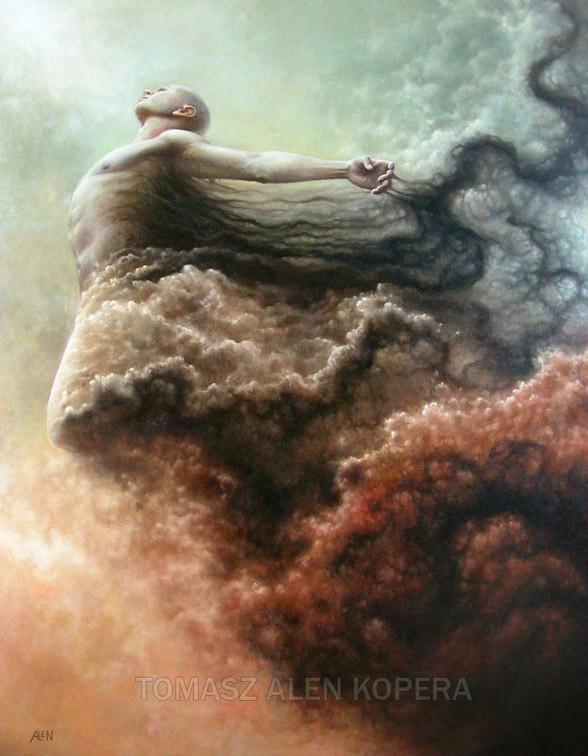
{Artwork by Tomasz Alen Kopera}

Thursday, July 26, 2012

Truth in Composite

Writing requires making choices. Writing fiction depends on those choices being unique enough to satisfy a saturated creative landscape, but at the same time contain enough generalities to unify the theme so that it is capable of communicating with a large, diverse number of readers. It is akin to the paradox, this complex synthesis of choice in that the imaginary must also fuse with the actual, to create the unique. Possibilities present themselves in a progressive stream for consideration; everything claims to be important enough to be included in the novel yet there is only so much space.

When I set out to write a series of stories about a young woman struggling through a network of opportunity that mirrored the landscapes which surrounded people I have observed, I intentionally turned my back on the particular details that were either experienced directly or through information relayed by association. To lift events directly from the lives around me felt like cheating.


The question remains: What should a writer include in their story? Wanting to avoid the specific design calculations that would render a novel some “Frankenstein-esque,” creation -- something shrewdly cobbled together to include as many resonant aspects as possible, so designed to speak to as great a number of readers as is possible would be the mark of failure. Such a strategically marketed approach would surely come at the expense of authentic characterization and an exposition guided by the imagination.


My hunch was that the solution to this dilemma could be found in turning the key to verisimilitude. It is in the specific details pertaining to your characters that will provide the alchemizing agent between what is familiar and what is unique.


How an incident or a person from your present life can ignite a sequence of events for a character is part of the mystery of inspiration, crystallized. Writers of fiction do not strive to be biographers, but instead allow an event or perhaps something as simple as an impression to guide the direction of their narrative. This may only be a brief period of influence or may act as a form of immediate association. Directness of the experience does not appear to factor; the imagination works with what is on hand.


It is not my desire to distract the reader by theorizing on the minds of the rich and famous. Yet their presence in the lives of those who lead more simple lives is inevitable. It must be included because it is true for the character so it is now my responsibility to craft this fascination into the story accordingly. This is the challenge -- weaving in something that goes against the grain of my own reason.


{Photographs by Man Ray}