Tuesday, August 28, 2012

Like Revelation

“Whatever we know of the world, there is always more.” - David Bohm
The opportunity to observe, then share discovery along this path of creative transformation feels like Providence. To encounter a broader perspective; to encourage deeper insights feels like some aspect of potent discovery exploding under the powers of subtle activation. Something has been missing up until the point of that exchange & in this sharing of self-knowledge & process, a circle is extended & the power to write sustains.

The task of bringing into a sense of balance the currents of emotion & the coherence of reason is a perpetual process of adjustment. These polarizing forces will be ongoing, cyclical in nature for the inspired writing which dictates these conditions. Being prepared for this balancing act feels like fortified relief.


When I first begin to write, I am a child learning to swim; shoreline is the end of a sentence. I paddle furiously towards the hands of safety that will hold me fast while I rest, waiting for the next lead. Through sentence after sentence I swim this way, each new word brought forth with the effort of a single stroke. Sometimes this happens smoothly, other time more careful & plodding. If I remain conscious of distance, say to the close of a paragraph, the task of each single stroke becomes fraught with self-consciousness & an awareness of the action itself.


The words become isolated & absurd; their meaning obscured.


So I begin to trust; trust that each period will teach the arc & grace of a sentence. Trust & over time, this begins to foster a sense of faith—faith that isolated units will converge into a coherent body: the paragraph. Through active process, this new trust is the vehicle driving a faltering will. It is a key to understanding this exchange & in believing it's all possible.


“. . . that these countless modifications, instincts with majesty, sweetness and irresistible appeal.” - Pierre Teilhard de Chardin

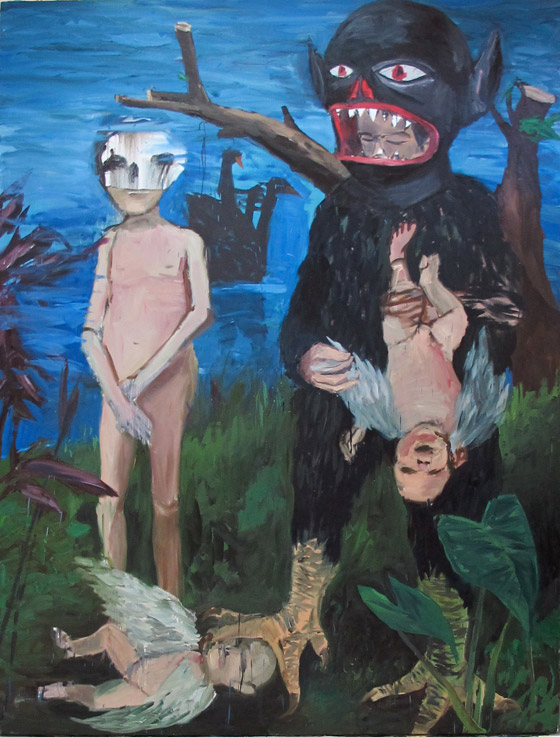
{Artwork by Stev'nn Hall}

Saturday, August 25, 2012

The Ritual of Creation


As a new writer, it is my will to encourage conditions which shall coach the exceptional from imagination. I wish to learn to harness this function in order to maintain work habits which will sustain & nourish the act of creation. I wish for this to be a gradual, manageable process that can respectfully be controlled & keep abreast of.

Many approaches will lead a writer to motivate actual work. We might directly confront the idle part of our nature & wage a series of negotiations with whatever distraction presents itself to divert intention from sitting down to create.


One tactic I have found especially effective is a challenge: I set goals in writing & this inscription of future intent motivates all now pre-determined accomplishment. My ego has been activated & responds to this form of a challenge. Collective writing jamborees are also useful in this same regard; also vowing to record a specified number of words or pages per day. Simple methods to encorage regular, flowing writing.


A writer might humour themself with the promise of some prized reward or we can blindly employ a force of will to write. Or else. I do not wish to be overwhelmed with the dread of not believing myself capable of achieving established goals. Fear can be an effective motivator because it has so much potential for self-torture in the realm of an underutilized imagination. Are any of these methods more effective in assisting ambition to be productive?

When creative function is inter-working & I, as writer or recorder of this synthesis is able to keep up to the output, there is a beautiful expansion of emotion which accompanies this productivity. Feelings of love, hope & relief; of balance & satisfaction inter-play to create a joyful, meaningful experience.


Maybe the most important insight is the proven awareness of the cyclical nature of spontaneous creativity, I wish to avoid the inverse of these more heightened, positive states. Through the inception of a preferred state of this mysterious process, I remain abreast of feelings of doubt & the quality of writing, or feelings of shame at not digging deeper or embarrassment for having once believed my work to be of merit.


I further discover that gratitude expressed in clear language for what imagination reveals is the most appropriate response for this revelation. When I allow an expectant ego to swell-up & command all the respect for what is being accomplished, I am then the most susceptible to the darker, more permeating emotions. When I remain thankful, I continue resourceful & open.


Intuition works above the level of everyday consciousness & requires a passage of time to be fully  integrated into writing. It is this expanded awareness which leads to understanding the need for reflection. When I am expectant, my conscious mind translates what the imagination or occasionally, my sense of intuition experiences & I falter in frustration & disappointment.


Another aim of this blog is to discover methods on which I can create a sacred space from which to accomplish this act of creation. What rituals will assist in helping this process and sustain this gratitude experienced for being able to accomplish goals? How might I balance the demands of everyday life with this more rarefied process?


{Images by Banksy}


Thursday, August 23, 2012

Spellbound

Which methods are best for coaxing property from imagination?


    The memory of this rapture is what keeps me working.


Writing has been the greatest influence of my adult life. It has shaped a viewpoint, determined ethical standards & perhaps most profoundly, engineered life strategies. This begins simply: in order to accommodate the demands made upon available writing time, a schedule is organized & a social circle is reduced to permit the greatest amount of hours unencumbered by external obligation. This time is critical for progress & it has taken many years to accept that more competing parties means less time to create a satisfactory portfolio.


The value of mystical domain becomes concrete when one begins to produce work. Before that time, experience within the inner world of imagination can be dissociative & lead to chronic alienation or in some cases, a form of depression.


It is through the act of writing that I am able to understand what is meant by the “spiritual.” In this manner, I refer to a sense of connectedness; a union with the mode of consciousness broader than everyday thinking.


Imagination is where we play out potentiality & resolution, safely & with license. When this connection is fluid, the experience of writing is exhilarating. Absorbed in this union of the force generated by a writer’s will, with the realm of the imaginary that so fascinates & compels, this is the creative process so often written about & canonized by those eager to impugn its fantastic, euphoric merits.


{Artwork by Keith Haring}


Tuesday, August 21, 2012

The Art of Imagining


I have read many remarks by writers who tell us that writing, or more specifically, the act of creating, is a process of discovery. They write without a map and trust so completely in this intuitive process that no decision as to the direction the narrative will take is made in advance. Played by ear this way, the process of writing becomes like walking along a road that appears below your feet upon each new step.

Other writers assume the role of cartographer and carefully map each section, knowing in advance what they plan to include in their story. They block-out the action, grid the rise and fall of the narrative and have already determined central plot points. It is formulated and followed exactly.


When the writing is flowing and surprising us, there is a sense of exhilarated delight that becomes the energising vehicle for continuing. When things are not going so swimmingly, the act of writing can be difficult; a drudge through of woods of disjointed sentences and half-remembered notions. It is my wish to reach a place of method where I can balance these extremes. Is it possible to reserve creative energy for this leaner time and then apply it as is needed?


Another way of phrasing this might be to say that the treasure I am seeking is not entirely dependent on the finished product, the words mined for the page but the method through which they have been procured. When I operate from this sequence, the act of writing begins to take on what might be described as an “automatic function.” It is this grace I wish to cultivate going forward.


It is at this time I feel most alert but also the most comfortable. I am capable, emotionally speaking, of riding the currents of this inspiration which seem to flow from an activated imagination.

I feel fulfilled and serene.


There is a fascination in de-constructing the act of writing and this is to be one of the focuses of this blog. What happens to us when our imagination becomes fully engaged and we are capable of translating what plays out on the screen of our imaginative mind into clear language? Can this be accomplished at will? Are there methods to assist in this phenomena? What are they? Do they come at a price to our overall mental health? Is living in the isolated world of creativity preferable to seeking regular input and stimulation?

Another aim of this blog is to commit to an exploration of what it means to be in possession of a practical sense of intuition. This seems to dove-tail lovingly with the concept of an educated imagination. Both of these are non-rational functions of the mind, when working together, serve as the engine for our creative voice.


In mastering this union, it is my belief that we move on to cultivate a relationship with our muse, that ineffable spirit of inspiration, who both illuminates and delivers. Perhaps most importantly, in being aware of this relationship, we are better placed in a position to accord it the tender respect it deserves.

We become aware of these relationships, but then are free to let them go. In this surrender, the effort we have invested to understand the working of imagination tends toward a confidence that the experience of writing is both lucid and manageable.


{Paintings by Wilfred Lang}

Saturday, August 18, 2012

The Search for the Muse - Courting Inspiration


Like the tides of oceans, inspiration arrives, then recedes.

What can be done to maximize the fruitful times, when this blessed wave of inspiration lands and it makes you feel as though it has never been any other way? Perhaps the first step is to acknowledge the existence of such an illumed state.


To sustain me through the difficult periods, I will be able to rely on what Hans Küng calls an “enlightened trust.” My faith in the existence of such an illuminated place is what permits it to return. I have chosen to accept that this cyclical cycle is not designed as some punishment for my not having accorded it the proper respect or for some other moral misstep I may have committed. Instead, I chose to see this grace arriving, as needed.


Is there a way for us, as writers eager to work regularly, to avoid what can only be called “a barren vacuum” of inspiration? I am certain we all experience it -- those times when we are motivated to capture some inspired work yet when we sit down to do so, our creative imagination appears to have taken some temporary leave.


We are like magicians dashing our hands into our top hats and finding there is no rabbit to pull out. Or worse -- the rabbit bites back.


In determining a relationship built upon respecting this informing force, I chose to believe it is intermittent. When inspiration strikes, I am prepared to receive it and so have constructed a system which accomplishes this effectively.

One of the objectives of writing this blog is to discover and hopefully discuss with others, this phenomena. It is this exploration that shall keep me out of the realms of superstition or fanaticism.


How can we come to better understand the conditions of our creative vitality? In these times, when our imagination has been freed and the mind is alert enough to be able to capture passionately what is being expressed, how may I better assist this miraculous exchange?


It is a goal of mine, as a writer, to live in respectful conformity with these more fruitful conditions and to remain free from a sense of entitlement that will render me expectant and disgruntled when the imagination recedes.

In the harmonization of these elements, I believe the truth will lie.


{Artwork by Yayoi Kusama}

Thursday, August 16, 2012

Broken Telephone

We writers cannot create in the style that surfaces from a circle of people creating a story by adding a new sentence each time the game revolves around to a new player. This is non-sequitous and uneven -- the thread of the narrative frays instantly and in no time the exercise becomes incoherent.

Writing is a conditioned occupation. One can hardly expect to be a lucid writer if words are not sequenced together in a conscious attempt at communicating something. Perhaps a message or an image; an instance.


A good writer must also be an avid reader. Part of our conditioning is establishing that place in our imaginations where intention transforms into language. I cannot imagine being able to do this on my own, in the dreaded “vacuum.” Without the generous works of others who have attempted the same feat, I know I would fail. This input is what tunes the machine.


A writer is also someone who has taken initiative to understand the process in their own mind. The various components of thought -- language, symbol, image, emotion, memory -- all of these take a different form in the interior landscape and so serve a different function within the plane of imagination. Each plays differently on the screen and it takes some degree of conditioning to learn to decode the images and discover what is being communicated, either in essence or in total.


How deeply we wish to probe into the mystery of writing will ebb and flow with the faith that corresponds to our present ability. When the work flows, like a gambler on a wining streak, I never wish to jinx that process by stopping to ask questions. When the mind struggles and the work falls short, it is then I begin to wonder.


Once the conditioning begins to take place, it demands an obedience from those it guides. It becomes essential to put into practice what has been revealed. A well cannot refill if it is never emptied and the act of creating does not appear to be different to this principle.


A writer must be able to trust their own memory. This is not the same as the recall of an eye witness but appears to be more akin to the recollection of someone who is re-creating an event to entertain a listener. As something actually happened  becomes the seed for the narrative, which is then transformed in the mechanics of imagination.


In this endeavour to educate the imagination, I shall first attempt to isolate and then explore the various influences which are capable of accomplishing this task.

{Artwork by Eduardo Berliner}


Tuesday, August 14, 2012

Some Mechanics

The discovery that I write for a deeper way of relating to the world around me should come as no surprise to those who follow the same pursuit. We experience something and we find ourselves working that experience through the mechanics of imagination, in the hope of finding it converted into some usable material for our portfolio. This is the process.

I am loathe to wallow in what often feels like narcissistic navel-gazing, but I also do not wish to proceed without making at least a preliminary effort at defining at what it means to be a writer.


To write something fictitious does not feel like I am trafficking in frivolous lies but am instead trying to render something back from the word of illusion. This created world relates.


Writing is an action which occurs in flux. It is rarely satisfied and appears to sustain itself upon the understanding that it must be accomplishing itself. It exists within this relationship, the place between imagination and page. I am never more concerned than when I think in terms of total satisfaction. The striving creates the engine for another attempt -- another pass through the gears of my mind in the bright hope that what is captured will be even more lucid than what existed before.


The most fertile distinction imaginable is writer as creator. Why should we not mirror the practises of Nature and create as our world dictates? The rules exists but should be ignored.

Being a writer implies that one has a sense of how to integrate. How else could we create a compelling narrative without this function? How is it possible to edit without some authority on what to include and possibly more pertinent, what to reserve?


As a musician works within the rules of harmony, tonal calculations which are specific and exact, so must a writer have some sense of what fits and what will prove to be discordant to the attentive reader.


An effective storyteller is someone who has learned to control potentialities in a dimension of creative freedom. The task of mastering how to direct one’s imagination, leaving it unsupervised, as it were, is to my understanding something that would come easily to a writer who has the potential of holding the readers attention. This is what separates passable fiction from distracted whimsy.


{Artwork by Zeng Fanzhi}